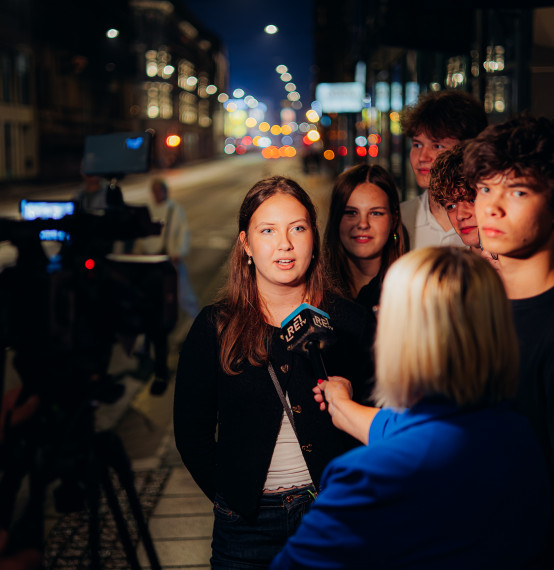
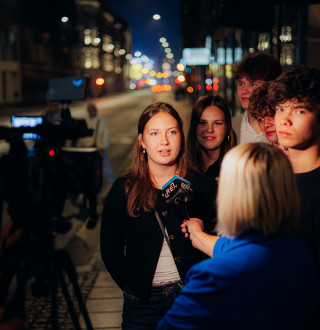
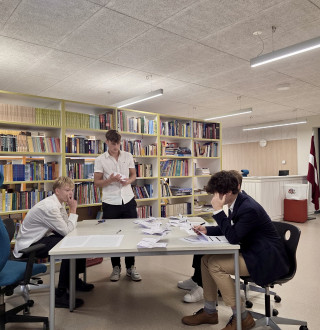

On Wednesday, 28 January, a press conference titled “Signal Elections 2026 in Latvian Educational Institutions” was held at the Ministry of Education and Science in Riga. The event marked the launch of the next phase of the Signal Elections 2026 project – an educational mock-election initiative that will take place this year in all Latvian municipalities and is a continuation of last year’s pilot project implemented ahead of the municipal elections.
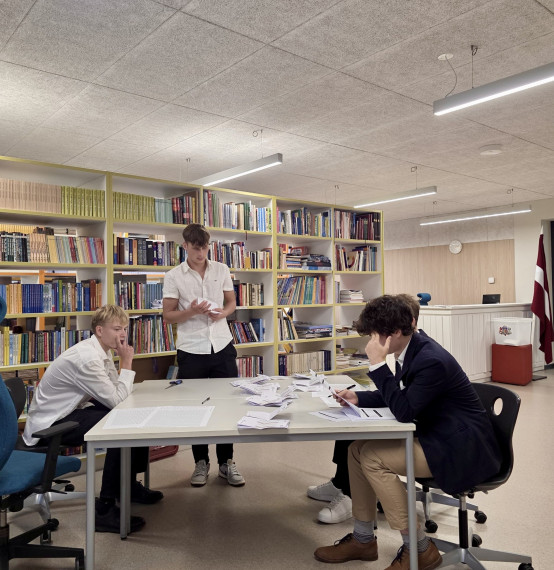
At the start of this new active phase, project organisers and representatives of partner organisations met with the press to explain how the Signal Elections will be implemented in 2026, to highlight the initiative in civic education and to outline preparations. The initiative inspired by the so-called mock-elections in the Nordic countries allows young people – future voters – to try out and practice voting process.
One of the main objectives is to improve young people’s knowledge of political processes, democracy and their rights and opportunities to influence developments in their city, municipality and country. Although voter turnout in recent parliamentary and municipal elections has increased, participation in Latvia remains comparatively low, and there are relatively few socially active young people. To strengthen youth participation in civic life and elections, the European Movement in Latvia, together with the Nordic Council of Ministers’ Office in Latvia and the Ministry of Education and Science, is organising the Signal Elections for the second consecutive year.
This year, mock-elections will take place in person rather than online, making the experience as close as possible to real elections. Chairman of the Central Election Commission (CEC) Māris Zviedris confirmed that the CEC will support voter education and, where possible, provide ballot boxes. He also noted that young people from the age of 16 may serve as official election observers to deepen their understanding of electoral procedures.
Secondary school student Kārlis Zikmanis noted that many young people lack the skills to navigate complex and often contradictory information about politics, politicians and elections. He considers that schools should be responsible for addressing such ‘knowledge barrier’.
“The current educational system doesn’t adequately prepare youngsters for elections. Many secondary school graduates have no idea how to vote, which is rather tragic. Schools must be involved, because NGOs alone cannot provide political education nationwide.” –Kārlis Zikmanis
The Ministry of Education and Science acknowledged these challenges and emphasised that cooperation with project partners is ongoing. Moreover, Director of the Nordic Council of Ministers’ Office in Latvia, Nina Hvid Enevoldsen, encouraged viewing the project in a broader context, stressing that Signal Elections are a long-term investment in democratic society, rather than a single-event exercise.
“Democracy is challenged not only on election day, but long before – through disinformation, polarisation and declining trust. That is why strong elections depend on civic resilience, and building it should start early.” –Nina Hvid Enevoldsen
An important element of the initiative is targeted teacher training; therefore, the Nordic Council of Ministers has arranged for the European Wergeland Centre (Norway) to train Latvian educators this spring. The intention is to introduce Nordic methodologies for teaching democracy and civic participation.
What changes in 2026: authenticity, scale and the role of schools
Three major changes will be introduced in 2026:
- In-person voting with paper ballots instead of online voting.
- Nationwide implementation across all municipalities.
- Increased responsibility for schools, with designated coordinators managing the process.
Moreover, organisers of the Signal Elections will provide schools guidance on setting up polling stations, ensuring secret ballots, preparing voter lists and counting votes.
The path to voting
From 29 January to 27 February, schools will be invited to appoint local coordinators. On 18 February, a youth co-creation forum “Youth Signal to Politics” will take place bringing youngsters together with representatives of political parties. Training and educational activities will follow in spring and summer. And political debates are planned for early September.
Voting will take place from 14 to 28 September, and results will be announced on 3 October at 20:01, after polling stations close, to reduce populism risks. Participants include students in grades 10–12 and vocational schools.
More information is available at www.signalvelesanas.lv.
The Signal Elections are implemented by the European Movement in Latvia and Club “The House”, with support from the Ministry of Education and Science and the Nordic Council of Ministers’ Office in Latvia. Participants in the press conference: Edgars Pukinsks, representative of the Latvian Ministry of Education and Science; Māris Zviedris, Chairman of the Central Election Commission; Nina Hvid Enevoldsen, Director of the Nordic Council of Ministers’ Office in Latvia; Liene Valdmane, Head of Signal Elections 2026 and Secretary General of the European Movement in Latvia; Svetlana Rimša, Youth Affairs Specialist of Ludza Municipality; and Kārlis Zikmanis, representative of the Student Council of Jelgava Spīdola State Gymnasium.
Photo: Laura Ķiršakmene, Kristers Zaļais